
“No wit without a portion of impertinence,” wrote Romantic poet John Wilson. And without question, Elisa D’Arrigo’s modestly scaled and wittily crafted ceramic sculptures at George Adams Gallery were proudly impertinent. From There to Here, 2022, appeared to be in the shape of a woman’s high-heeled shoe. But the front portion (or vamp, as it’s provocatively referred to by cobblers), meant to shield the top of the foot and cover the toes, resembles a penis with a bulbous black head. This perversely hermaphroditic work epitomizes the artist’s erotic wit and surreal sense of irony, which we saw in many of the abstract pieces that were on view. Pile Up 2, 2025, was also phallic, resembling a swirling green-and-yellow tower that might collapse at any moment. Whatever her formal inventiveness—particularly when she references the human body—D’Arrigo makes objects that are implicitly expressionistic, charged with emotional Sturm und Drang, all of which is conveyed by their writhing shapes and painterly facture.
The artist’s “formal irony,” as I’d like to characterize it, prevailed in Implement, 2024, and A Leg Up 5, 2025. Their hollowed-out appendages look like found objects—pipes?—implying that the works are satirical constructions. The sculptures’ quixotic—not to say absurdly fantastic—geometry possesses a visceral and oddly lurid flair. Consider Underling 4, 2024, which resembled an exotic marine animal, stuffed and mounted for our delectation. Its sickly shiny-blue exoskeleton is adumbrated by a series of gooey pink lumps. The object itself, wide and flat like a degenerate anemone, has a bloodred limb sprouting from its side, as if it is searching for something to furtively palpate, then violently throw into its gaping maw. The titles of these works were frequently suggestive, conveying their comical and otherworldly strangeness (Underling is a fitting name for this gelatinous-looking, bottom-feeding creature). D’Arrigo also made clear that modernist experimentation and individualism are not obsolete. Baudelaire’s “sensation of the new” remains possible in art, not because the times are new but because genuine creativity will always be sensational and fresh.
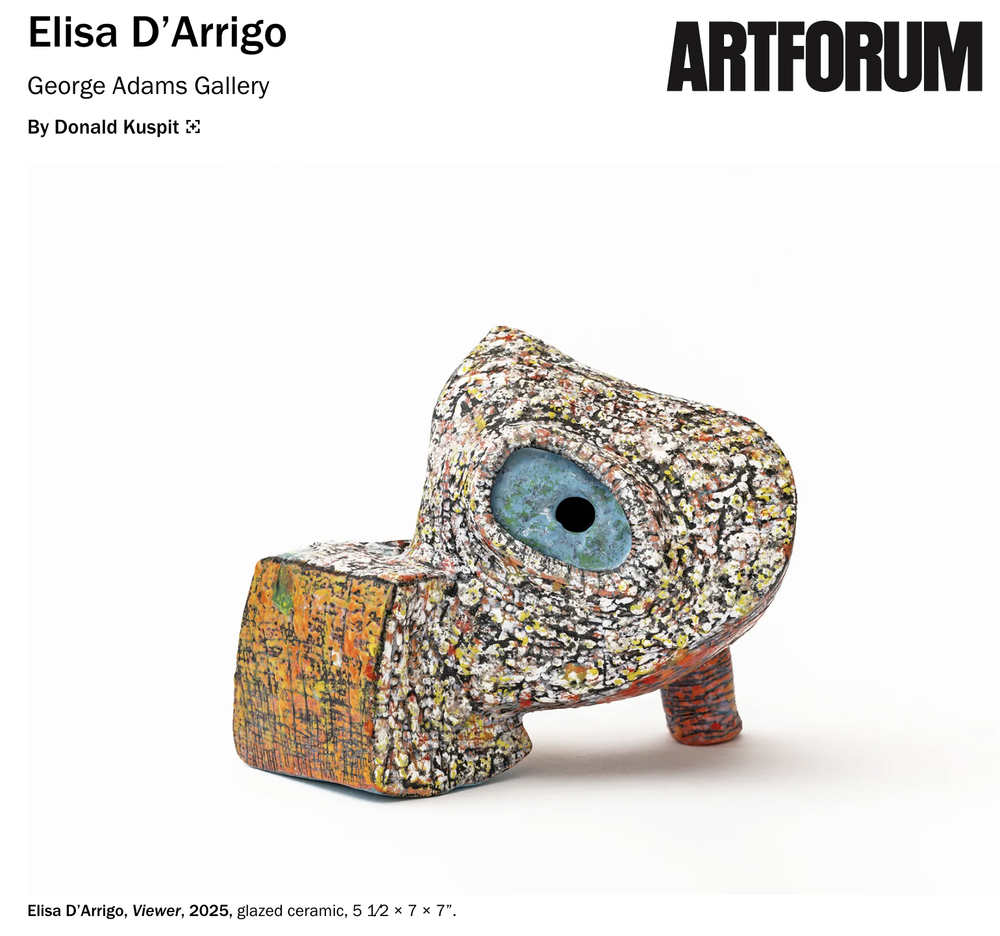
Perhaps the key piece in this exhibition was Viewer, 2025, a sort of glorified blob with a cube-like torso. It possesses one large eye, whose pupil is slightly off-center. The sculpture, roughly six inches high, is a marriage—or rather, a precarious union—of opposites. Without such negative dialectics, per Theodor Adorno’s concept, there is no modern art. In this light, then, one might classify D’Arrigo’s ceramics as being neo-modern. But the bigger question might be: Who is the viewer of Viewer? Is it I, the observer, gazing at this object? Or is it the object itself, an animistic little thing that appears to be gazing right back at me? In the tale of Odysseus, the titular hero, trapped in the cave of a Cyclops, famously introduces himself to the giant as Nobody—part of a plan to deceive and eventually flee the monster. Perhaps D’Arrigo was performing a similar kind of trick here—making her Viewer the Nobody so that it could make its grand metaphysical escape. As a spectator, watching it all unfold was wonderful.